


24 Mar Choosing Between MIG and Stick Welding
As one of the oldest fabrication techniques still in use today, welding has come a long way since the days of forge welding, where heating and hammering was used to join molten metals. The last 100 years have seen enormous advancements in technology, with modern techniques making mobile welding possible in many types of locations.
Welding steel requires specific conditions and technologies, and two of the most commonly used techniques are MIG and stick welding. Unless you’ve used either of these techniques before, you’re not likely to know how they work and therefore won’t be able to choose between the two. As experts in mobile welding, Baker Steel Trading understand the benefits of each option and hope that this blog post will help you do the same.
What is Stick Welding?
Most steel fabricators are experienced in using this technique of welding steel, which gets its name from the metal stick that’s charged to create an arc of electricity at a high temperature. Coded welding can use the current flowing between the stick and the metal to form the necessary joints.
Stick welding is a powerful technique that can efficiently connect most metals, including steel. However, this power also isn’t suitable for particularly thin or light metal pieces. Understanding the pros and cons of the technique is a great way to learn whether shielded metal arc welding (another name for stick welding) is the best option for your project.
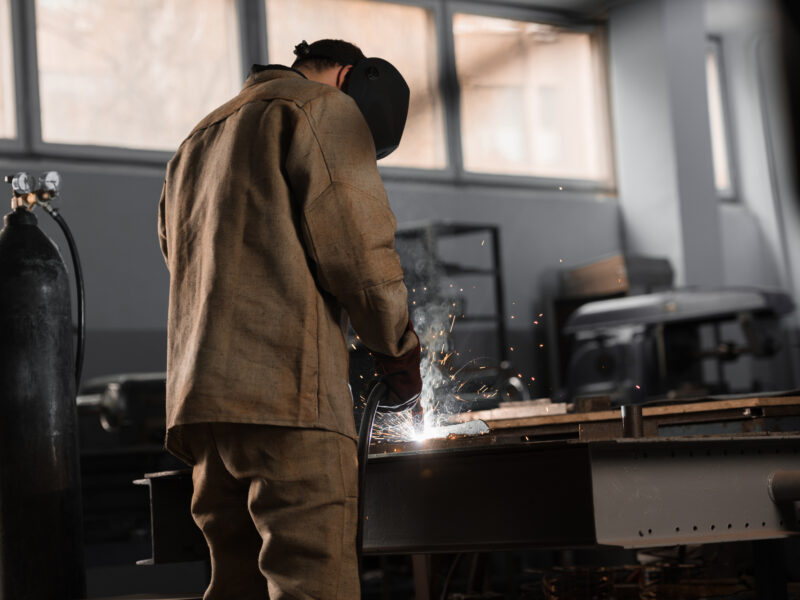
Pros and Cons of Stick Welding
Advantages:
- Arc welding isn’t affected by any paint or existing corrosion at the welding point.
- The arc created by this technique is powerful enough to work in most conditions, including in winds and varying temperatures.
- Particularly suitable for mobile welding requests.
Disadvantages:
- Some spatter will likely be created during the welding process.
- The rod used in stick welding needs to be replaced occasionally, interrupting the process and extending the time required to complete it.
- As mentioned above, the arc created through stick welding is powerful, making this structural steel fabrication method unsuitable for types of metal thinner than 18 gauge.
What is MIG Welding?
MIG stands for Metal Inert Gas, another popular type of welding that operates using a wire welding electrode on a spool. As with stick welding, an arc is created using an electrical current, but in this case, the current melts the wire and the metal to form a strong bond.
The simplistic nature of MIG welding has earned it the nickname of being “the hot glue gun of welding”. This mobile welding option is popular because it’s relatively easy to do and requires little cleanup time after welding is complete. Review the pros and cons below to understand whether it’s the best option for your project’s requirements.
Pros and Cons of MIG Welding
Advantages:
- The precision of MIG welding means it can be used on metal as thin as 24 gauge.
- This mobile welding method results in minimal spatter, making the welded product easier to prepare for use.
- No delays are caused by using this method as the wire feeding is automatically replaced by the spool.
Disadvantages:
- MIG welding is significantly weakened by any rust or paint on the metal component, which must therefore be cleaned before welding begins.
- Wind can disrupt the shielding gases essential to the process, instantly making a MIG welder less efficient.
- To work correctly, MIG welding requires the usage of pressurised gas bottles, making this option less suitable for mobile welding.
Which Mobile Welding Option is Best?
While every customer will have a different preference on the type of welding they want, Baker Steel Trading recommends that the mobile welding technique be chosen based on the conditions of your site. If weather conditions can be controlled, then MIG welding should be used. If there’s any possibility of wind or other conditions affecting the welding process, then stick welding is a much more reliable option.
Request Mobile Welding Services Today
Hopefully, this blog post has helped you understand how two of the most common structural steel welding machines work. If it has and you’re ready to request mobile welding services, get in touch with Baker Steel Trading today. Our experienced coded welders can work on sites based across Surrey, Hampshire and Berkshire.